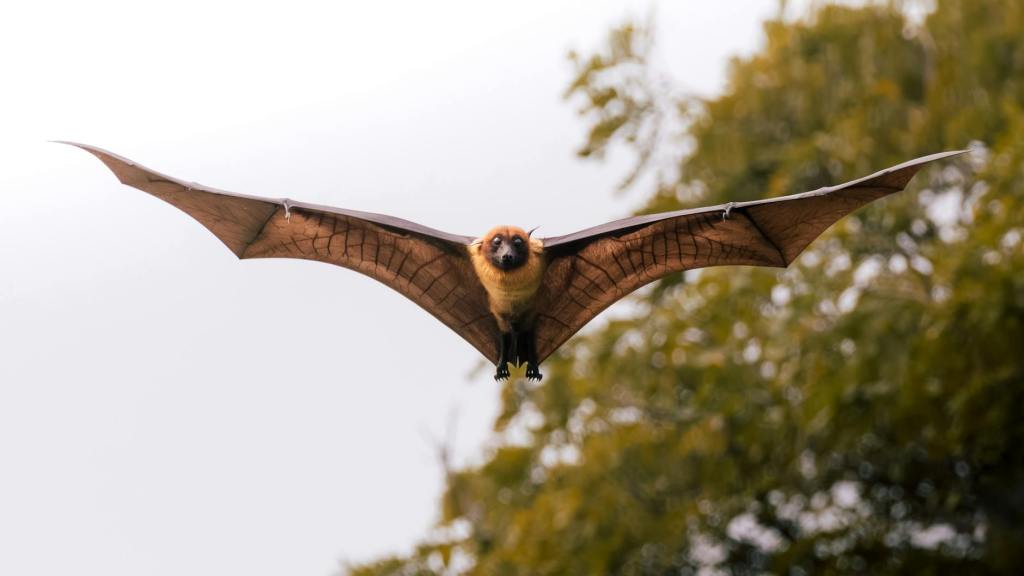
Can we ever truly understand what it is like to be another animal?
In 1974, Thomas Nagel published what would become one of the most well-known papers in the field of philosophy of mind: “What Is It Like to Be a Bat?”
What does it mean for an organism to have conscious experience?
According to Nagel, the question of what it is like to be a bat is the question of what a bat’s conscious experience would be like.
“The fact that an organism has conscious experience at all means, basically, that there is something it is like to be that organism.”
This idea–what it is like to be something–is also referred to as the subjective character of experience.
Part of the reason this paper is so well-known is because of its rather pithy definition of consciousness. The other major reason is what Nagel goes on to argue about what implications this has for studying the biological basis of consciousness.
Why Bats?
When I first read this paper, for an article I was writing on nonhuman consciousness, I was talking to someone about it and the first thing they said was, “well, why bats? Why did he choose bats?” I guess for those of us who aren’t bat enthusiasts, it might seem a bit random.
Nagel actually does address his reasons for using bats as the example:
“I have chosen bats instead of wasps or flounders because if one travels too far down the phylogenetic tree, people gradually shed their faith that there is experience there at all. Bats, although more closely related to us than those other species, nevertheless present a range of activity and a sensory apparatus so different from ours that the problem I want to pose is exceptionally vivid”
Basically, bats were a good example because they are similar enough to humans for us to easily imagine consciousness in them, but different enough to make it extremely difficult for us to map our own subjective experience onto them.
This is particularly pronounced when considering a bat’s use of echolocation, rather than sight, to navigate. Trying to imagine what it would be like to echolocate is nearly impossible (at least for me) with no experiential reference point.
Humanly-Inaccessible Facts and Animal Subjective Experience
Even if we do our best to imagine what it would be like to live like bats do, all we would really be doing, Nagel argues, is imagining what it would be like to behave as a bat– not to be a bat, as a bat would experience it.
But we aren’t wondering what it would be like for a human to act like a bat, or even for a human to be a bat– we want to know what it is like for a bat to be a bat. And this seems to be, at least currently, impossible.
“Reflection on what it is like to be a bat seems to lead us, therefore, to the conclusion that there are facts that do not consist in the truth of propositions expressible in a human language. We can be compelled to recognize the existence of such facts without being able to state or comprehend them.”
The question of what is it like to be a bat can be considered a humanly-inaccessible fact.
It is something we may never be able to know. Crucially, though, this does not mean we can assume bats, or other animals, lack a subjective experience. An alien species with human-like intelligence would not be able to understand the subjective experience of being a human for similar reasons, yet we know that humans are conscious and have subjective experiences.
The Limitations of Physicalism
In philosophy, physicalism is the idea that everything that exists can be reduced to a physical process.
In the context of consciousness, physicalism is the idea that consciousness emerges purely from physical processes, like the firing of neurons.
However, how can physical processes explain the subjective character of experience?
The Subjective and the Objective
Before getting into the weeds of this, it’s important to understand how Nagel conceptualizes subjective and objective.
Something subjective is something that is only able to be understood from a particular point of view. Your subjective conscious experience can only really be fully understood by you, yourself.
Something objective, however, is independently verifiable and can be accessed and understood regardless of point of view.
Nagel argues that because we lack the ability to attain a bat’s perspective in order to assess what it is like to be a bat, conscious experience has a clear subjective component. However, a physical process cannot be subjective. Events in the physical world, like the firing of neurons, can be independently monitored and verified by an observer.
Is there any part of consciousness– of what it is like to be a bat– that could be measured objectively?
“Very little work has been done on the basic question (from which mention of the brain can be entirely omitted) whether any sense can be made of experiences’ having an objective character at all. Does it make sense, in other words, to ask what my experiences are really like, as opposed to how they appear to me?”
According to Nagel– at least when he was writing, in 1974 — we don’t seem to be able to get anywhere close to definitively answering this. For physicalism to work, though, either objective processes must be able to explain subjective ones–which is not currently known–or conscious experience must be objective.
Implications for the Mind-Body Problem
The mind-body problem is the question in philosophy and neuroscience of whether mental processes are physical processes. Is what happens in your mind merely a physical process like the goings-on in the rest of your body, or does it encompass something else as well?
Nagel doesn’t attempt to stake out a position on the mind-body problem debate in this essay; rather, he concludes by pointing out that until we can come to a better understanding of subjectivity and objectivity with regard to the bat question, the mind-body problem will likely remain insoluble.

 Philosophy for Animals
Leave a comment